
The Forum Project
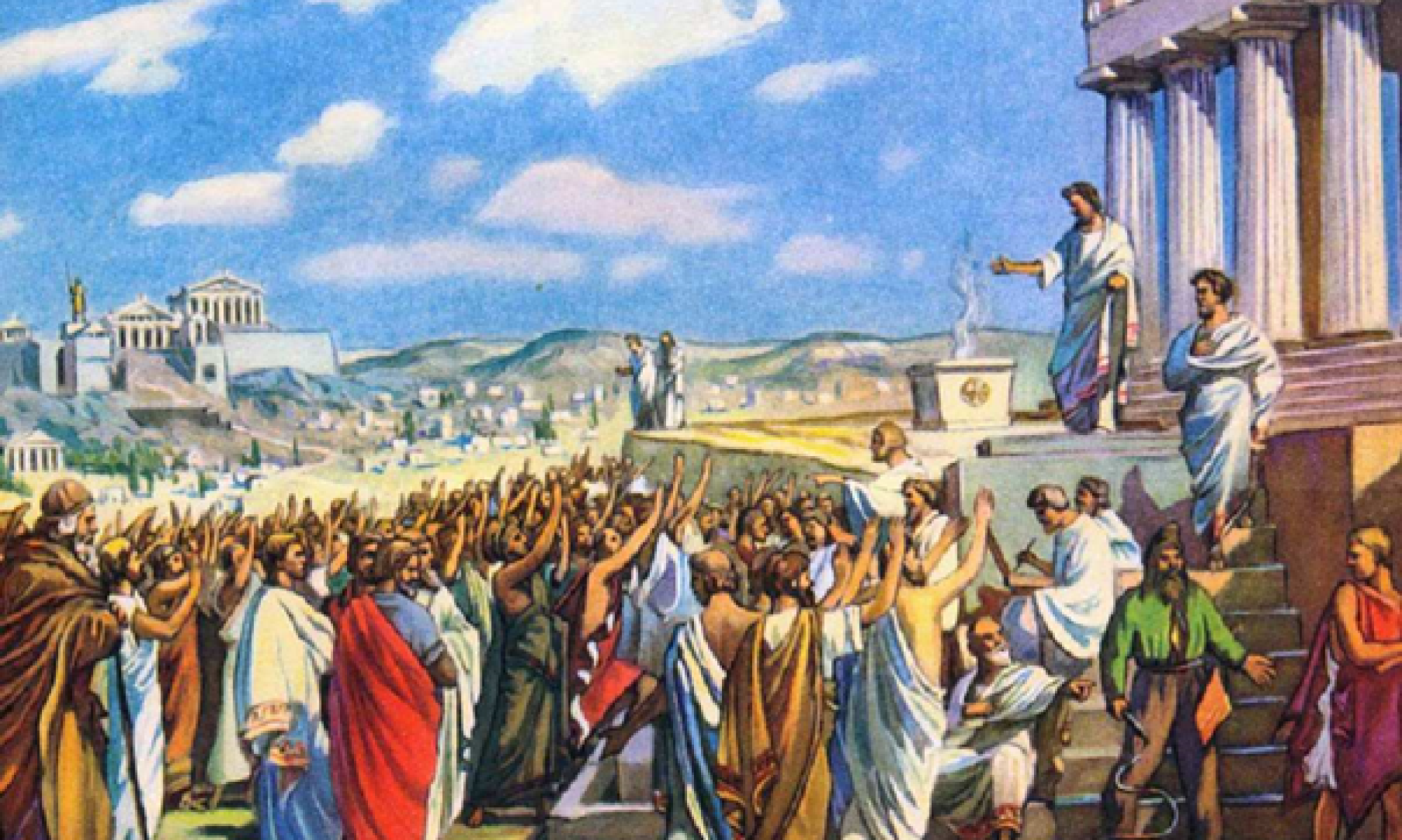
The Forum Project is dedicated to bringing direct democracy to the UK. We believe that ordinary people are better placed than any representative to decide how their towns, counties and country should be run.
Here at the Forum Project, we believe in people power. Our ethos is grounded in respect for the individual, as an engaged and competent participant in civic life.
Our vision is to have the vast majority of decisions made democratically. “Democracy” literally means “rule by the people”, and we strongly feel that it’s the best way to run any group – from a sports club to a city council, from a company to a country.
If direct democracy is so great, why don’t we use it already?
We actually use it all the time, just on very small scales. This is the natural way of making hard decisions that affect more than one person. You discuss and debate the issues, working towards creative solutions that work for everyone. Forum’s vision is to take this innate collective intelligence, and scale it up to larger, more important decisions.
The last few hundred years have seen tremendous innovation in so many fields, but governance has been strangely left behind. Governance is “a system that provides a framework for managing organisations”. Or, the art and science of running an organisation.
Most other systems use a hierarchical model for making decisions. Hierarchies are generally efficient, and we don’t want to eliminate them. The thing is, they often do a bad job of integrating feedback, and don’t represent people’s interests equally.
Before the information age, it wasn’t practical to get more than about 15 people together in a room, to discuss collective decisions. For most of human history, we had to rely on systems of hierarchy, bureaucracy and representation.
In the information age, things are different. Nearly all of us have a smartphone in our pocket, and modern innovations in voting design have given us a historic opportunity to organise differently. To have a political order that’s smarter, more bottom-up, and more effective.
What does it look like, does everyone vote on everything?
Not exactly, though it’s true that more people vote on more decisions than before. Let’s say your company starts using Forum, to help make smarter decisions that serve everyone’s interests. The first step is for major decision-makers, such as the board of directors, to make a public commitment to abide by the popular vote, at least for some decisions.
We understand that implementing direct democracy is a big step, and many people will be cautious about throwing the floodgates wide open. This is why we suggest a commitment to following the ‘will of the people’ on certain issues, while exercising discretion on others, and treating the process more like a poll than an election.
When it comes to using a direct democratic system like Forum, people can create their own polls, and vote on other people’s polls. What happens after a poll closes and the results are in, is up to the organisation. If they’ve made a binding commitment to follow the result of a poll, the result automatically becomes official policy. If not, it’s one among a number of elements that go into making a decision, but still exerts some influence.
*Note that we’ll be using ‘vote’ and ‘poll’ interchangeably; the only difference is that one has more authority than the other.
Can you really trust the ‘will of the people’ for big decisions?
In a word, yes. The ‘democratic’ systems we have now, valuable though they are, are a poor substitute for true direct democracy. They usually suffer from problems like tactical voting, voter exclusion, and decision-makers re-interpreting results (or simply ignoring them).
Direct democracy is different. The systems used in Forum, principally QV, are designed from the ground up to be tamper-proof. They give voters (or survey respondents) much more flexibility to express how they really feel, than putting a single cross in a single box.
Another major advantage that Forum brings is that, due to the modern user interface and housing in an app, it makes voting easier and more convenient than ever before. This makes it feasible to run several mini-elections and consultations each month, rather than a single election once per year at an AGM.
The final advantage of continual, direct-democratic engagement, is that it corrects both co-ordination failure, and abuse of power, much more quickly than any other mechanism, while being hard to corrupt itself. When everyone in a company is free to create a poll on anything they like, giving their own feedback and inviting others to do the same, problems quickly come to the attention of the people responsible for solving them. Any policy or initiative that helps a few people, while causing harm to many more, will be quickly voted off the table, in favour of a more well-thought-out approach.
You’ll often hear it said that that ‘people can’t be trusted’. And it’s true in a sense: put any one person in charge, and they’ll probably make a lot of mistakes. This can happen even when the person is bright, well-intentioned, and supported by a team of advisors.
Things change when you spread the decision-making power equally, among large numbers of people. At a large enough scale, everyone’s biases, blind spots and mistakes all cancel out. The right information shines through, and so do the most effective solutions.
What’s Forum’s master plan?
The Forum Project is currently seeking partner organisations to help trial the system. These trials are completely free, and are expected to take only half an hour per month to run. We’re mainly targeting organisations such as companies, clubs, voluntary associations, schools and universities. Feel free to contact us if you’d like to take part.
Once the trials are complete, and the system has been stress-tested, we will begin development of the app. Because this will require significant input from UI/UX professionals and programmers, it will be necessary to hold keep certain features behind a paywall, for a period of time. Rest assured that none of the free features will ever become pay-to-play, and we will commit to making the paid ones free, once certain financial thresholds are met.
This income will enable us to make the best possible version of the app, to the benefit of both paying and non-paying users. From the beginning, the company will practice full accounting transparency, so that anyone can see exactly how we spend your money. There’s no legal obligation to do this, but as this is a public service project we feel a moral obligation to be transparent.
Our vision is a near future in which more and more organisations are using Forum for, all kinds of decisions. As time goes on and the system, not to mention its underlying philosophy, prove their worth, people will trust this method for ever more important decisions.
We expect that the trust and respect for this method of governance will spill over, from groups and organisations, to local and national government. First expressed through the open system, the combined thoughts and feelings of millions of Britons will exert a positive influence on the entire structure of politics. This is grassroots democracy in action, and we can’t wait to get you on board.
Credit for cover image: https://www.thecollector.com/government-direct-democracy-republic/